
|
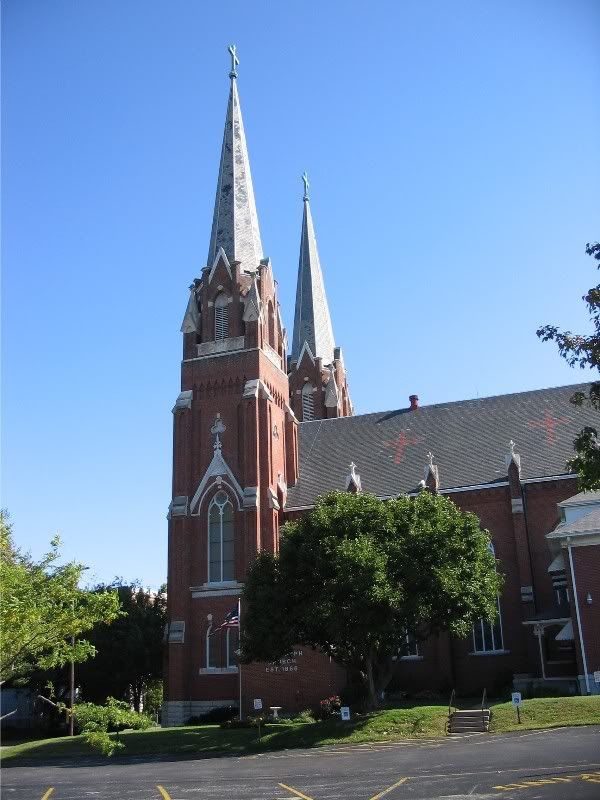
With the development of the section of Louisville known as “Butchertown,” then at the eastern edge of the city, came a number of Catholic families. Those speaking German had to go to either St. Martin of Tours or to the more distant St. Boniface Church, both far enough to make church going inconvenient. When, therefore, their number justified it, the Right Reverend Martin John Spalding, Bishop of Louisville, determined that they should have a parish of their own. The hard task of organizing the new congregation, to be placed under the patronage of St. Joseph, was entrusted to the Reverend Leopold Walterspiel, a native of the grand duchy of Baden and one of the first priests sent to Kentucky from the American College of Louvain in Belgium. A site for the proposed building was obtained on the south side of Washington Street, between Adams and Webster Streets, and the plans were drawn up for a modest combination structure. The very Reverend Benedict Spalding, Vicar General of the diocese, with the Concordia Choral Society which enhanced the occasion with several selections, laid the cornerstone on August 13, 1865. The building was completed and dedicated on January 6, 1866, by the Right Reverend Peter J. Lavialle, Bishop of Louisville. This combination edifice, which is still standing and in use included space for school and hall purposes, including classrooms on the first floor and the church on the second. Looking at the list of names of the pioneer parishioners, one would gain the impression that St. Joseph Parish at its inception was for the German Catholics exclusively. This, however, was not the case. Originally it was a so-called “mixed” parish composed of both Irish and German families, a condition that lasted until 1876-1877 until the Celtic-speaking Catholics obtained their own church on the corner of Washington and Buchanan Streets. During these formative years the first two pastors of St. Joseph’s were continually harassed by financial difficulties. Money was hard to obtain, and the debts of the parish mounted. Father Van der Hagen could no longer cope with the situation, and when he was transferred to St. Louis Church in Henderson, KY, in May 1875, a change in the administrators of the parish took place. Bishop McCloskey asked the Franciscans Fathers of Cincinnati, who were already working in Louisville at St. Boniface Church, to take charge of St. Joseph’s, and when Father Ubald Webersinke, O.F.M., their superior, agreed, Father Luke Gottbehoede, O.F.M., of St. Boniface Church, was sent to assume temporary charge until June 1875 when Father Eugene Butterman, O.F.M. was appointed first Franciscan pastor of the parish. After 127 years of Franciscan spirituality, the shortage in vocation to religious life and the priesthood pressed the Franciscans to leave our parish in 2002. An energetic diocesan priest was assigned to St. Joseph for the first time, Fr. Jack Schindler. But his time in our parish was short. Fr. Jack passed away in December 2003, as he led a group of parishioners on a trip to Germany. With the shortage of priests and religious communities, our universal Church has examined and tested new models of Church. Churches without a resident priest are growing in our local area. Administrators and sacramental moderators are more visible today. Understanding the theology behind these new models may be difficult for some communities. Sr. Justina Heneghan R.S.M., succeeded Fr. Jack after his death and became the first pastoral administrator of St. Joseph with the help of Fr. Patrick Delahanty as sacramental moderator. |
Con el desarrollo de la sección de Louisville conocida como “Butchertown”, entonces en el extremo este de la ciudad, llegaron varias familias católicas. Los que hablaban alemán tenían que ir a San Martín de Tours o a la más distante iglesia de San Bonifacio, ambas lo suficientemente lejos como para que el acceso a la iglesia fuera un inconveniente. Por lo tanto, cuando su número lo justificó, el reverendo Martin John Spalding, obispo de Louisville, determinó que debían tener una parroquia propia. La difícil tarea de organizar la nueva congregación, que sería puesta bajo el patrocinio de San José, fue confiada al Reverendo Leopold Walterspiel, natural del gran ducado de Baden y uno de los primeros sacerdotes enviados a Kentucky desde el Colegio Americano de Lovaina en Bélgica. Se obtuvo un sitio para el edificio propuesto en el lado sur de Washington Street, entre las calles Adams y Webster, y se elaboraron los planos para una estructura combinada modesta. El muy Reverendo Benedict Spalding, Vicario General de la diócesis, con la Sociedad Coral Concordia que realzó la ocasión con varias selecciones, colocó la primera piedra el 13 de agosto de 1865. El edificio fue terminado y dedicado el 6 de enero de 1866 por el Reverendo Peter J. Lavialle, Obispo de Louisville. Este edificio combinado, que todavía está en pie y en uso, incluía espacio para la escuela y el salón, incluidas las aulas en el primer piso y la iglesia en el segundo. Al observar la lista de nombres de los feligreses pioneros, uno tendría la impresión de que la parroquia de St. Joseph en sus inicios era exclusivamente para los católicos alemanes. Sin embargo, este no fue el caso. Originalmente era una parroquia denominada “mixta” compuesta por familias irlandesas y alemanas, condición que duró hasta 1876-1877 hasta que los católicos de habla celta obtuvieron su propia iglesia en la esquina de las calles Washington y Buchanan. Durante estos años de formación, los dos primeros pastores de San José fueron continuamente acosados por dificultades financieras. Era difícil conseguir dinero y las deudas de la parroquia aumentaron. El padre Van der Hagen ya no pudo hacer frente a la situación, y cuando fue trasladado a la iglesia de St. Louis en Henderson, KY, en mayo de 1875, se produjo un cambio en los administradores de la parroquia. El obispo McCloskey pidió a los Padres Franciscanos de Cincinnati, que ya estaban trabajando en Louisville en la Iglesia St. Boniface, que se hicieran cargo de St. Joseph, y cuando el Padre Ubald Webersinke, O.F.M., su superior, estuvo de acuerdo, el Padre Luke Gottbehoede, O.F.M., de la Iglesia St. Boniface, fue enviado para asumir el cargo temporal hasta junio de 1875, cuando el Padre Eugene Butterman, O.F.M. Fue nombrado primer párroco franciscano de la parroquia. Después de 127 años de espiritualidad franciscana, la escasez de vocación a la vida religiosa y al sacerdocio presionó a los franciscanos a abandonar nuestra parroquia en 2002. Por primera vez se asignó a San José un sacerdote diocesano enérgico, el P. Jack Schindler. Pero su tiempo en nuestra parroquia fue corto. P. Jack falleció en diciembre de 2003, mientras dirigía a un grupo de feligreses en un viaje a Alemania. Ante la escasez de sacerdotes y de comunidades religiosas, nuestra Iglesia universal ha examinado y probado nuevos modelos de Iglesia. Las iglesias sin un sacerdote residente están creciendo en nuestra área local. Los administradores y moderadores sacramentales son hoy más visibles. Comprender la teología detrás de estos nuevos modelos puede resultar difícil para algunas comunidades. Sor Justina Heneghan R.S.M., sucedió al P. Jack después de su muerte y se convirtió en el primer administrador pastoral de San José con la ayuda del P. Patrick Delahanty como moderador sacramental. |
A Brief History | Una Breve Historia